
Development has changing fast and dramatically in the last decade. due to introduction of AI.
We moved from physical server to virtual to containers and now we are using serverless architecture.
But after listening this word “serverless architecture” everyone get confused, if it’s “serverless”… where is the server? but the server is still exists. You just don’t manage it.
Let’s Simplify it properly.
What is Serverless Architecture?
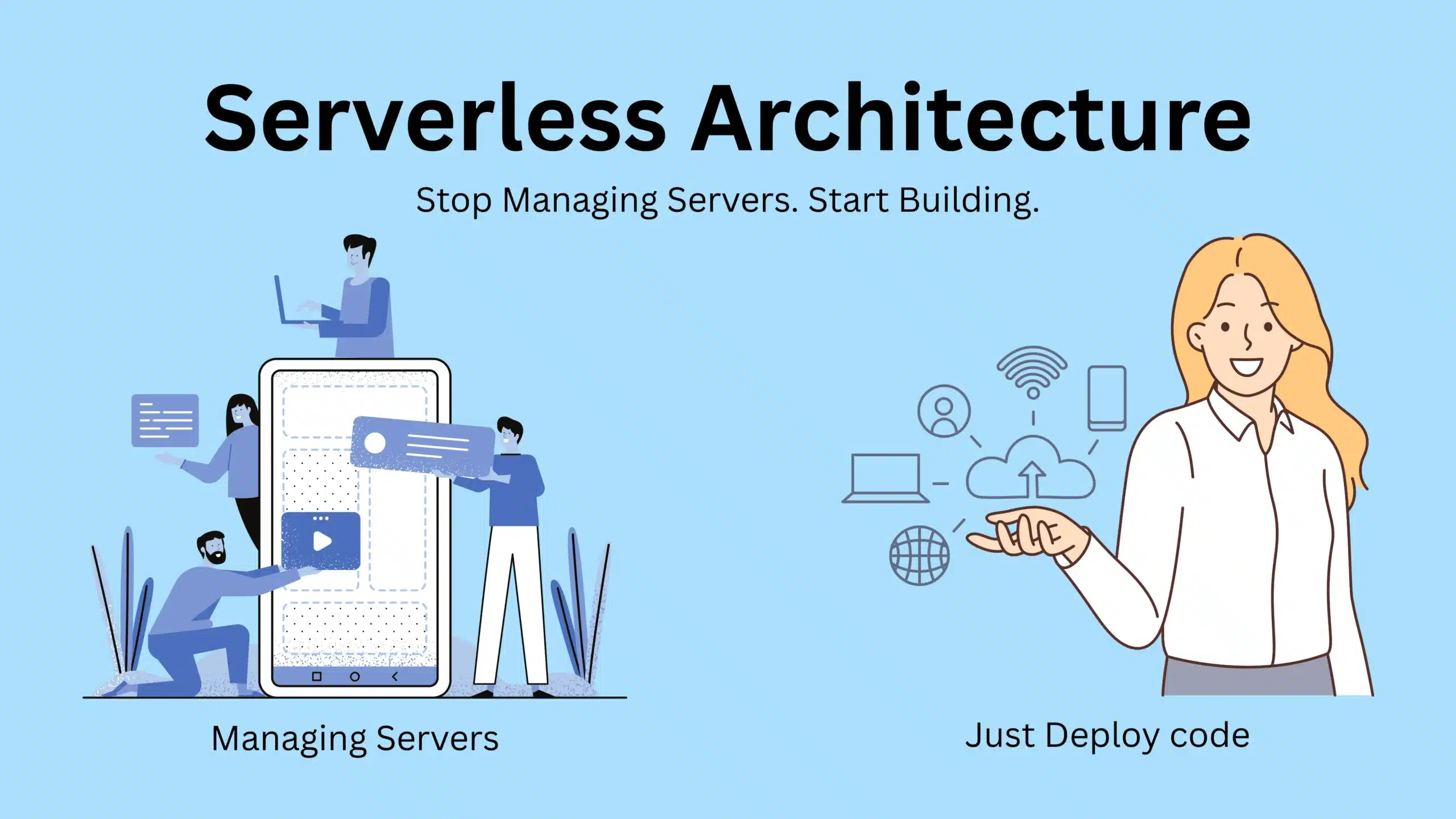
It is a cloud computing model where the cloud provider manages infrastructure, and you focus only on writing code.
You don’t:
- Provision servers
- Patch operating systems
- Configure scaling rules
- Manage load balancers
instead, you deploy your code, and the cloud provider automatically:
- scale it & maintain it
- Secures the infrastructure
- Charges you only when it runs
The core concept is
In traditional setup: you manage servers and deploy applications on them.
but, in Serverless Architecture you just deploy functions or services. the cloud will manage everything else.
It’s all about abstraction and operational simplicity.
Core Components of Serverless Architecture
1. Function as a Service (FaaS)
These are the most common examples of “serverless”. You write small functions that run in response to events. Like you familiar with them or ever worked on these services: AWS Lambda, Microsoft Azure Functions, and Google Cloud Functions.
They are Stateless, Event-driven, Auto-scaling, and Pay per execution. Mostly used for the APIs, Background jobs, Event processing, and Microservices.
2. Serverless Storage
You store large no. of files or docs without managing disks or servers. These services eliminate the need to manage capacity and performance manually, enabling seamless integration with serverless applications. Most commonly we used Amazon S3, Azure Blob storage, and Google Cloud Storage.
They also support to optimize storage costs and management. Mostly they used for Static Websites, Image uploads, Media files and Data lakes.
3. Serverless Databases
You ever read or work on serverless databases? Both SQL and NoSQL serverless database options eliminate the need to manage servers while automatically scaling based on demand. These databases are ideal for event-driven apps, real-time analytics, and user-focused applications. e.g. Aurora Serverless, Cloud Spanner, DynamoDB, Cosmos DB, Firebase Realtime Database.
4. Serverless API Management
These platforms allow you to build, publish, and monitor APIs at scale without the complexity of managing backend infrastructure. These tools are highly effective to streamline API lifecycle management and enhance security.
Ok, So this is basically technical details of serverless architecture lets understand this with a real life example to understand this:
Imagine You want to open a food delivery business
In Traditional way you need to handle all rent the building, buy kitchen equipment, hire cleaning staff, maintain electricity and plumbing, handle security and manage staff schedules. and worst thing is that if still you don’t get customers, you still pay rent and salaries.
But if get this as Serverless Setup like Cloud Kitchen Platform: now you have only to focus on cooking food that’s your core skill. All other thing will be provided by cloud kitchen platform and you charged only per order, if there are no orders, you don’t need to pay.
Pros of Serverless Architecture
1. Cost Efficiency
you need to pay only when your function runs. if no traffic = no cost.
This is most effective for startups, student projects, mvps, event-driven apps and irregular traffic patterns.
2. Automatic Scaling
it totally depends on your audience if your traffic suddenly rise it scales automatically, and if traffic drops it will automatically scales down.
3. Faster Development
Development and scalability of business also increase as you only need to focus on business logics, features and APIs. All other thing will be automatically handled by server maintenance, OS patches and infrastructure tuning
4. Built-in High Availability
Cloud providers design serverless systems with redundancy and fault tolerance. You get resilience without managing clusters.
Read about “Ai Agents vs Traditional Automation”
Cons of Serverless Architecture
1. Cold Starts
After making and deploying if your function hasn’t been used for a long time, the first request you generate may be slower. this will effect in Real-time apps, Low-latency APIs, and financial systems.
2. Vendor Lock in
if your architecture depends heavily on one provider’s services, migrating becomes difficult. like switching from AWS Lambda to Azure Functions is not always simple.
3. Execution Limits
If you are working on Serverless Architecture it not provides yo complete independence it comes up with some limitations like Time limits, Memory limits, and Storage constraints.
4. Cost at Large Scale
This is bit confusing like you know some time it less costly and some time it’s highly costly because it is cheap for low to medium scale, but at sustained high traffic can exceed container or VM based solutions that increases the cost.
When Should you use Serverless Architecture?
Most of the time we use it for:
- Event driven Applications, like resizing of image.
- APIs for web or mobile Apps
- For Microservices: Like Authentication, payments, Notification and Basic Analytics
- Uses in Small MVP and Startup Projects it will helps in Fast Launching, low cost and helps in scale automatically if products grows.
- IOT and Real time Data
When Should You Avoid Serverless Architecture?
Mostly we don’t use this in
- Long running batch jobs
- High performance gaming servers
- Persistent WebSocket heavy apps
- Extremely latency sensitive workloads
- Predictable heavy traffic 24/7
- In these cases, containers or Kubernetes may be better.
Best Practices for Developers
If you are choosing serverless architecture, you have to keep in mind these things:
- Keep Functions Small, Single responsibility, Do one thing well avoid using multiple.
- Monitor Everything, Logs, Tracing and Metrics.
- Secure by Design: It not provide security you have to keep in mind and try to apply least privilege IAM roles, validate all inputs, and Encrypt sensitive data.
- Control cost, set budgets and optimize execution time.
- Consider Hybrid Architecture
Conclusion
Serverless Architecture is not a magical instrument that can do everything and also it’s not a replacement for everything. It is a powerful abstraction layer that removes operational overhead and accelerates development.
- It’s perfect for learning cloud native design
- It increases productivity
- it reduces early infrastructure costs.
But at large scale or for steady workloads, evaluate alternatives carefully
Key Point is:
Use serverless Architecture where elasticity matter most.
Read about similar topics Cybersecurity Practices and How to learn react.
Read About AI Impact Summit 2026 in India
[…] ever think about servers or serverless architecture. check this for more […]