
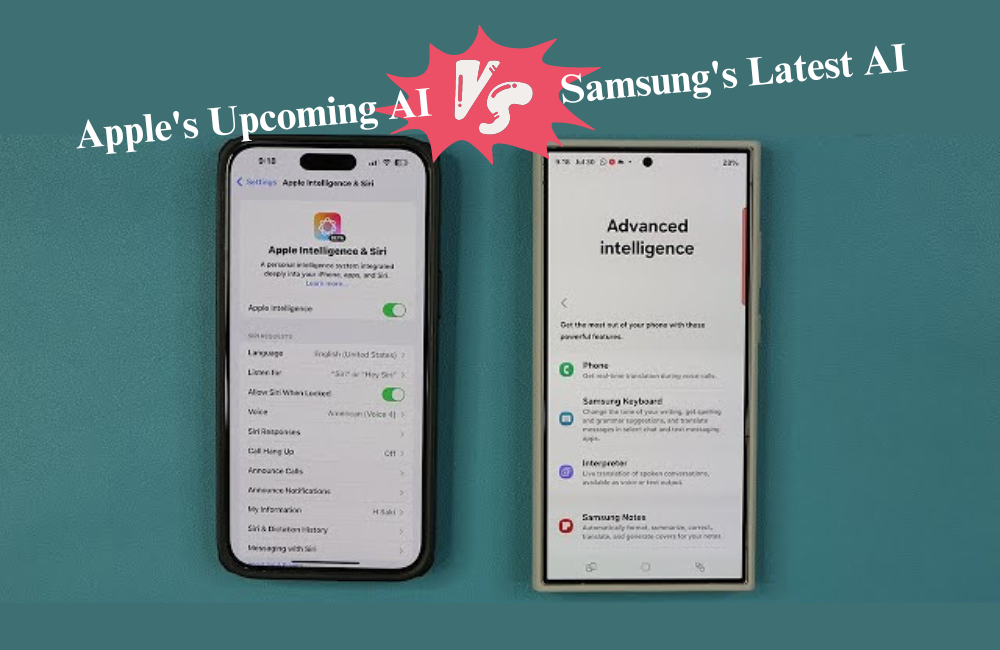
Artificial Intelligence is fast becoming very important and integral in shaping the future of tech, especially smartphones. Apple and Samsung are both known for pushing the envelope on this front. But have you ever thought what lies beneath? How, exactly, do these AIs work, and what makes them different? More importantly, how do students learn about these technologies?
In this blog, we will break down the core technologies behind Apple’s upcoming AI and Samsung’s latest AI. We will explain how these work and also let you know how to study these skills for yourself.
1. The Core of AI in Smartphones: How Does AI Work?
Before drilling deep into the details of AI in Apple and Samsung, let’s step back first to understand how AI works in modern-day smartphones. AI makes a machine or software perform things that might be considered intelligent if done by a human. It involves learning from data, speech recognition, image processing, and decision-making.
AI works on smartphones to make them increasingly responsive and tailor-fit to the user’s experience. This involves optimizing battery life, anticipating what is important for the user, enhancing the camera, and conveying smart assistants in the form of talkative assistants, including Siri from Apple and Bixby from Samsung.
The fundamental base of these AI running smartphones involves machine learning and natural language processing.
Key Concepts:
Machine Learning (ML): This is a sub-branch of AI whereby machines learn from data to make predictions, without being explicitly programmed. This is how Siri and Bixby improve over time and get good at knowing what you want.
Natural Language Processing: it’s the technology that enables machines to understand and interpret human languages; it powers all AI assistants like Siri and Bixby.
2. Incoming AI Apple: The Tech Behind
Siri and Core ML
Artificial Intelligence at Apple is driven, to a large degree, by Siri. Siri is not just any voice assistant; it is the crowning glory of years of improvement in field of NLP and ML. Core ML, or, more specifically, Apple’s Machine Learning Framework, is one of the chief technologies underpinning Siri.
How Core ML works: Core ML is that with the help of which developers will be able to create an application that will use machine learning models. Core ML can perform a great variety of tasks-from recognizing images and texts to making predictions based on user behavior. The power of Core ML is that it does all this on the device, without cloud servers. In this way, it guarantees both privacy and the speed of processes because data will not need to leave your phone.
Neural Engine in Apple Devices
If it weren’t for the Neural Engine-a special chip built into their latest A-series processors, such as the A16 Bionic-it would not be able to run as quickly or as smoothly. The Neural Engine will run artificial intelligence and machine learning computations exclusively on a special chip. It does billions of operations per second, which enables real-time processing for tasks running on the particular device-from Face ID to AR and image processing.
Learning Opportunity: The student eager to learn how to develop an AI system like that of Apple, should begin learning the programming language of Apple, Swift, followed by Core ML. You will find plenty of resources on the Apple developer site, inclusive of how you can put the machine learning models into apps.
Image and Speech Recognition
AI is also used in the camera system of Apple. Apple does computational photography, wherein AI enhances photo quality. One example is Deep Fusion in iPhones, which combines some images into a photo that has more detail and less noise.
In speech recognition, Siri’s continuous improvement in language and different accents continues to push forward. It has started to make use of the end-to-end deep learning models. These have been the things that allowed transcription to do its thing in real-time. For any student interested, studying deep learning and neural networks will give you a great foundation of how Apple does speech recognition.
3. Samsung’s Newest AI: Understanding the Technology
Samsung approaches AI somewhat differently from Apple. They focus heavily on integrating the use of AI across all their devices to create a more connected ecosystem from smartphones to smart home devices. The current flagship AI assistant that Samsung has is Bixby. It also uses NLP and ML, just like Siri, to perceive and act on voice commands.
Bixby and Vision AI
Bixby is Samsung’s version of Siri, and it’s designed to be deeply integrated with the Samsung ecosystem. Capable of opening apps, setting reminders, or even controlling smart home devices, Bixby can perform many functions.
In the case of Samsung, Bixby itself is one of the standout features; this lets your camera identify objects, translate text, and more so you can shop online. It does this through computer vision, which is the subfield of AI designed to let machines “see” and make sense of the visual world.
How Bixby Vision Works:
Object Recognition: Bixby Vision uses convolutional neural networks to analyze images and recognize objects. The class of deep learning models that works especially well with images is called convolutional neural networks.
Real-time Translation: On the other hand, Bixby Vision can make real-time translations of texts because of the use of various NLP models that are trained in multiple languages.
Learning Opportunity: In case you want to understand how Samsung implements AI features like Bixby Vision, then you need to study the concept of TensorFlow or PyTorch to understand the deep learning frameworks put into place in image recognition tasks. Computer vision forms the heart of the development of AI applications.
Exynos Processor and Neural Processing Unit (NPU)
Powered by their Exynos processors, Samsung’s latest AI features are not left out. Similar to the Apple Neural Engine, there is an NPU on Samsung’s Exynos processors. That NPU is designed to accelerate AI tasks such as object recognition, real-time improvements in video, and in-game performance.
Key Benefit: Samsung devices’ NPU can process several tasks related to AI all at once without performance compromise. That means Samsung phones are powerfully efficient at multitasking, gaming, or using augmented reality applications.
Camera AI and Image Processing
Samsung’s AI is also impressive in its camera technology: Samsung smartphones use AI to automatically detect scenes and adjust camera settings. For example, if one is taking a picture of a sunset, the AI will increase colors and vibrancy of brightness to make the image pop.
4. In What Ways Students Can Learn About AI Technologies Behind Apple and Samsung?
The path to understanding AI technologies used by Apple and Samsung requires commitment and a focus on key areas of AI development. Here is a step-by-step manner through which students can start with the process:
1. Machine Learning and Deep Learning:
Learning Resources: You can learn from courses related to machine learning and deep learning on famous online platforms like Coursera and Udacity. Learning the basic concept of how a neural network works will be important in getting used to the AI systems working in both Apple and Samsung devices.
Recommended Books: One notable book is “Deep Learning” by Ian Goodfellow. It is a great book which covers the very fundamentals of Neural Networks and Deep Learning. I highly recommend this reading for students interested in AI.
2. Programming Languages:
To work on Apple’s AI: one should know Swift. Core ML, Apple’s AI framework, works most ideally with Swift, which is the language used to develop iOS.
To work on Samsung’s AI: one should learn Python. Python is one of the most in-demand languages when it comes to AI development. Most of the AI capabilities designed at Samsung are based on frameworks like TensorFlow or Keras; hence, Python-based.
3. Natural Language Processing (NLP):
Learning Resources: Understanding how Siri and Bixby work will involve deep dives into NLP with learning resources such as Stanford’s courses on NLP and online tutorials on Kaggle.
Book Recommendations: “Speech and Language Processing” by Daniel Jurafsky and James H. Martin is recommended for students who delve deep into the subject of NLP.
4. AI in Camera Technology:
Computer Vision: Learn computer vision using the resources of OpenCV, and Open Source Computer Vision Library. Convey the explanation of Convolutional Neural Networks in this regard.
5. Future Scope: Where Is AI Headed for Apple and Samsung?
Apple’s Future AI Plans:
Apple has been focusing on on-device AI for privacy reasons. The future of Apple’s AI will likely see more advanced AR experiences, as Apple is rumored to be working on AR headsets. AI will also play a role in improving health monitoring features in devices like the Apple Watch.
Samsung’s Future AI Plans:
Samsung is betting heavily on AI for smart homes. The company’s focus on connecting AI across multiple devices (IoT) will become even more prominent. With the rise of 5G, Samsung is also looking at AI in areas like autonomous vehicles and smart cities.
Conclusion: How Does the AI Showdown Between Apple and Samsung Stack Up?
Both are strong in AI capabilities, but varied approaches. While Apple will be all about privacy and on-device AI, on the other hand, Samsung is pretty strong in creating an ecosystem that starts beyond smartphones. Both companies can be said to be leading in AI, but for students, there could not be a better time to learn all the technologies powering these systems.
[…] Check here for best mobiles. […]
[…] Read about Apple AI vs Samsung AI. […]