
Introduction
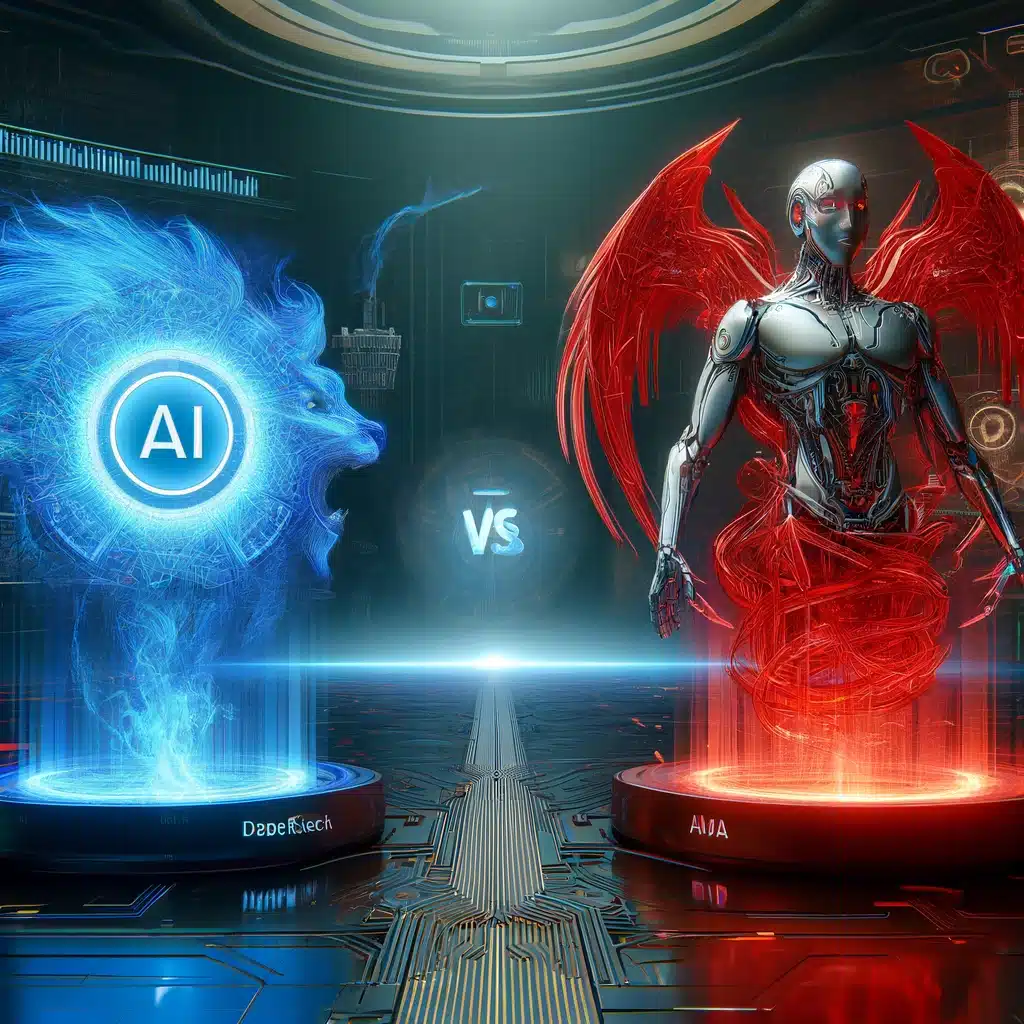
Artificial Intelligence (AI) chatbots have revolutionized the way we interact with technology. Among the most advanced AI models, OpenAI’s ChatGPT and China’s DeepSeek AI have emerged as top contenders. While ChatGPT has dominated the AI chatbot market for years, DeepSeek AI has recently gained attention for its innovative approach and rapid adoption. In this blog, we will compare these two AI models in depth, analyzing their features, performance, advantages, and drawbacks.
Background: What Are DeepSeek AI and ChatGPT?
ChatGPT
ChatGPT, developed by OpenAI, is a state-of-the-art large language model (LLM) designed to generate human-like text. OpenAI has continuously improved its models, from GPT-3 to GPT-4, making ChatGPT a leading AI assistant for various applications such as customer support, content creation, and code generation.
Key Features of ChatGPT:
- Based on OpenAI’s GPT architecture (currently GPT-4)
- Available in free and premium versions (GPT-4 Turbo for paid users)
- Strong general knowledge and contextual understanding
- Integrations with Microsoft (Copilot) and third-party apps
- Reinforcement Learning with Human Feedback (RLHF) for better responses
- Highly developed natural language processing (NLP) capabilities
- Support for multiple languages
- More about Chat gpt, Read here:
DeepSeek AI
It, developed by a Chinese AI company, is an emerging competitor to ChatGPT. Launched in 2025, DeepSeek AI quickly gained popularity due to its cost efficiency, competitive performance, and availability in multiple languages.
Key Features of DeepSeek AI:
- Open-source large language models (DeepSeek-R1)
- Lower computational costs than ChatGPT
- Claimed to provide competitive performance with GPT-4
- Free chatbot app available on iOS and Android
- Rapidly growing user base
- Optimized for Chinese language processing
- Focused on cost-effective AI solutions for enterprises
Performance Comparison: DeepSeek AI vs ChatGPT
1. Accuracy and Knowledge Base
ChatGPT has been trained on a massive dataset with reinforcement learning, making it highly accurate for general knowledge, programming, and creative tasks. However, It has been criticized for generating inaccurate responses, particularly in politically sensitive topics, where it reflects Chinese government viewpoints.
DeepSeek AI’s knowledge base is still expanding, but it struggles with complex, nuanced discussions, sometimes providing outdated or incorrect information. ChatGPT, on the other hand, has been fine-tuned with a diverse dataset, making it more reliable in academic, technical, and general queries.
Winner: ChatGPT (better accuracy and broader knowledge base)
2. Speed and Efficiency
DeepSeek AI boasts a more efficient model that requires fewer computational resources while maintaining competitive performance. This makes it a cost-effective solution, especially for businesses looking to integrate AI chatbots without significant infrastructure investment.
ChatGPT, while powerful, requires a significant amount of computational power, especially in its premium versions. The trade-off for better performance is higher resource consumption, making DeepSeek AI a viable alternative for those who need a lightweight, cost-effective solution.
Winner: DeepSeek AI (more efficient and cost-effective)
3. Language Support and Global Reach
ChatGPT supports multiple languages, including English, Spanish, French, Chinese, and many others. DeepSeek AI, being a relatively new model, primarily focuses on Chinese users but is expanding its multilingual capabilities.
DeepSeek AI has made significant improvements in Chinese-language processing, making it a preferred choice for users in China. However, its global language support still lags behind ChatGPT, which has been trained on a wider dataset with more extensive language diversity.
Winner: ChatGPT (wider language support and global availability)
4. Creative and Coding Abilities
ChatGPT is widely used for creative writing, coding assistance, and debugging. Its integration with platforms like GitHub Copilot makes it a favorite among developers. DeepSeek AI also offers coding capabilities but has yet to match ChatGPT’s versatility.
Developers using ChatGPT can generate, debug, and optimize code with ease, whereas DeepSeek is still in the early stages of developing strong programming capabilities. While DeepSeek AI may offer some assistance in coding, it currently lacks the refinement and extensive libraries that ChatGPT provides.
Winner: ChatGPT (better coding and creative assistance)
5. User Experience and Accessibility
DeepSeek AI recently launched a free chatbot app, which quickly became the most downloaded free app on iOS. ChatGPT, on the other hand, is accessible through web browsers, apps, and integrations with various platforms.
Both AI models have user-friendly interfaces, but ChatGPT’s integration with Microsoft and various APIs makes it more versatile for business and personal use. DeepSeek AI is a good alternative for those looking for a free, mobile-friendly AI chatbot.
Winner: Tie (both offer accessible platforms)
Advantages and Limitations
Advantages of ChatGPT:
- More accurate and reliable responses
- Advanced coding and creative writing support
- Global reach and language diversity
- Stronger integrations with third-party services
- Constant updates and improvements
Limitations of ChatGPT:
- Higher computational costs
- Requires a subscription for the best model (GPT-4 Turbo)
- Some answers may be overly cautious due to safety guidelines
Advantages of DeepSeek AI:
- Lower cost and efficient resource utilization
- Rapid adoption and availability as a free mobile app
- Open-source model, allowing for community improvements
- Stronger focus on Chinese-language processing
Limitations of DeepSeek AI:
- Accuracy issues and potential misinformation
- Limited global reach and language support
- Lack of third-party integrations compared to ChatGPT
- Possible censorship and bias in responses
You ever think about servers or serverless architecture. check this for more details.
Controversies and Challenges
1. Censorship and Bias
DeepSeek AI has been found to favor Chinese government narratives, leading to concerns about misinformation and bias. In contrast, ChatGPT aims to provide neutral responses, though it still faces occasional biases. Users needing unbiased, fact-checked answers may prefer ChatGPT over DeepSeek AI.
2. Intellectual Property Concerns
OpenAI has accused DeepSeek of using its proprietary models to train a competing LLM. If proven, this could lead to legal consequences for DeepSeek, potentially affecting its future development.
Conclusion: Which AI Model is Better?
The choice between DeepSeek AI and ChatGPT depends on user needs:
- For accuracy, coding, and creativity: it is the better option.
- For cost-efficiency and mobile accessibility: it is a strong contender.
However, ChatGPT remains the preferred choice for most users due to its reliability, global support, and advanced capabilities. While DeepSeek AI is an interesting competitor, it still has hurdles to overcome before it can truly rival OpenAI’s ChatGPT.
Frequently Asked Questions (FAQs) – DeepSeek AI
1. What is DeepSeek AI?
it is an advanced artificial intelligence platform known for large-language models optimized for efficient reasoning, long-context processing, and cost-effective performance. It competes with other AI models like ChatGPT by offering open-source models and powerful reasoning capabilities
2. How does DeepSeek AI differ from ChatGPT?
This emphasizes efficiency, lower operational cost, and strong reasoning in technical tasks, while ChatGPT focuses on broader language generation, creative tasks, and ease of use. DeepSeek models may require more technical setup compared with ChatGPT’s plug-and-play interface.
3. Is DeepSeek AI free to use?
Yes — DeepSeek AI’s consumer chatbot app is currently free to use, often with unlimited access, making it more affordable compared with subscription-based models like ChatGPT.
4. Can DeepSeek handle long text and documents?
Yes — DeepSeek supports very long context lengths (up to ~128,000 tokens), allowing it to process long conversations, documents, or extended text inputs effectively.
5. Does DeepSeek AI have limitations?
Some assessments have found that DeepSeek may produce less reliable responses in certain contexts or have vulnerabilities in bias and safety guardrails compared to more mature models
[…] latest artificial intelligence trends […]
[…] Deep seak AI vs ChatGPT […]
Yo, 100 jilislot got some fire slots! Been hitting some nice wins lately. The layout’s clean, easy to find what you’re looking for. Worth checking out if you’re chasing those jackpots! Go check out 100jilislot now!
[…] They are excellent in unstructured, decision heavy, and conversational tsks where flexibility and reasoning are more important then strict predictability. Deepseek ai vs chat gpt […]
[…] Read about Deep seek AI […]